

What Are ‘New Collar’ Jobs? The Rise of Skills-Based Hiring

📝 Key Takeaways
New collar jobs are roles that demand specialized technical or soft skills. To fill these positions, organizations rapidly adopt skill-based hiring to build their teams.
- Labor shortages and technological advancements drive this major workforce transition.
- Employers evaluate candidates strictly on verifiable capabilities and applied experience.
- Updating recruitment practices instantly unlocks wider, more diverse talent pools.
- Internal retraining programs prepare existing employees for emerging technical roles.
The growing demand for new collar jobs is changing how organizations build their teams. For years, a four-year college degree served as a strict filter for high-paying roles. But as labor availability tightens and technology alters the workplace, employers are finding that academic backgrounds do not always predict on-the-job success.
If you source talent, you know the frustration of leaving a critical position vacant because the traditional applicant pool lacks qualified candidates. Skills-based hiring offers a practical solution. It directs recruitment efforts toward verifiable capabilities and adaptability rather than a candidate’s pedigree.
This article defines these emerging roles, highlights key examples across industries, explores the macro forces driving their growth, and outlines how companies are adapting their hiring pipelines to secure talent.
What Are ‘New Collar’ Jobs?
New collar jobs are roles that demand specialized technical or soft skills rather than a traditional four-year college degree. Candidates build these required competencies through alternative educational routes. They graduate from coding bootcamps, earn specific industry certificates, attend vocational schools, or gain extensive hands-on experience.

Breaking the collar binary
Former IBM CEO Ginni Rometty coined the term to highlight a fundamental change in the labor market. Historically, society split employment into two strict categories: blue-collar roles involved manual labor, and white-collar jobs required a university diploma.
New collar work bridges that historical divide by focusing entirely on actual competency. If an applicant can write the software, operate the advanced machinery, or secure the cloud network, their lack of a bachelor’s degree no longer stops them from landing the job.
Top New Collar Jobs Spanning the Modern Economy
These roles exist across both emerging and established sectors. Employers actively seek candidates for these positions based on technical proficiency and adaptability.

Here’s a look at where you will find the most growth:
- Technology and data: Every industry needs digital talent. Roles like cybersecurity analysts, cloud infrastructure administrators, and software developers remain in high demand. Candidates frequently acquire the necessary coding and networking skills through intensive bootcamps or industry-recognized certifications.
- Advanced manufacturing: The modern factory floor relies on complex technology. This sector needs robotics operators, mechatronics technicians, and CNC machinists. Operating and troubleshooting automated systems requires specific technical training rather than a broad academic background.
- Green economy: The push for a net-zero transition is creating a massive wave of new positions. Capital spending on renewable energy and sustainable infrastructure drives demand for wind turbine technicians, solar photovoltaic installers, and electric vehicle battery specialists. These sectors generate thousands of high-paying job opportunities without a degree.
- Healthcare: An aging population guarantees continuous demand for healthcare services. Medical records technicians, pharmacy technicians, and specialized personal care aides are critical to the system. Workers secure these roles through focused vocational training and state certifications.

Image from Generative AI and the Future of Work in America by McKinsey & Company
Macro Forces Driving the Shift to New Collar Jobs
What is forcing this massive realignment? You can trace the pivot away from degrees to five distinct economic and technological pressures.
1. Alternative credential boom
Soaring university tuition costs push talent toward specialized bootcamps and micro-credentials. Programs like Google or IBM career certificates provide rigorous, job-ready training at a fraction of the cost of a traditional degree.
2. Generative AI and automation
AI accelerates the timeline for workplace automation. By 2030, technology could automate up to 30% of current work hours in the US. European markets face similar automation rates. Employers need adaptable problem solvers right now instead of candidates with static academic knowledge.
3. Labor crunch
Shrinking working-age populations and massive retirement waves leave critical roles unfilled. The US anticipates nearly 12 million occupational transitions by the end of the decade. Europe expects up to 12 million transitions of its own. You simply cannot afford to filter out capable candidates based on arbitrary credential requirements.
4. Federal infrastructure investments
Massive capital injections into green energy and infrastructure demand millions of skilled tradespeople and technicians. These roles prioritize hard skills and specific certifications over college diplomas.
5. Shortening half-life of skills
Technical capabilities become outdated rapidly. Employers expect 39% of workers’ core skills to change by 2030. Continuous learning and agility matter far more than a degree earned a decade ago.
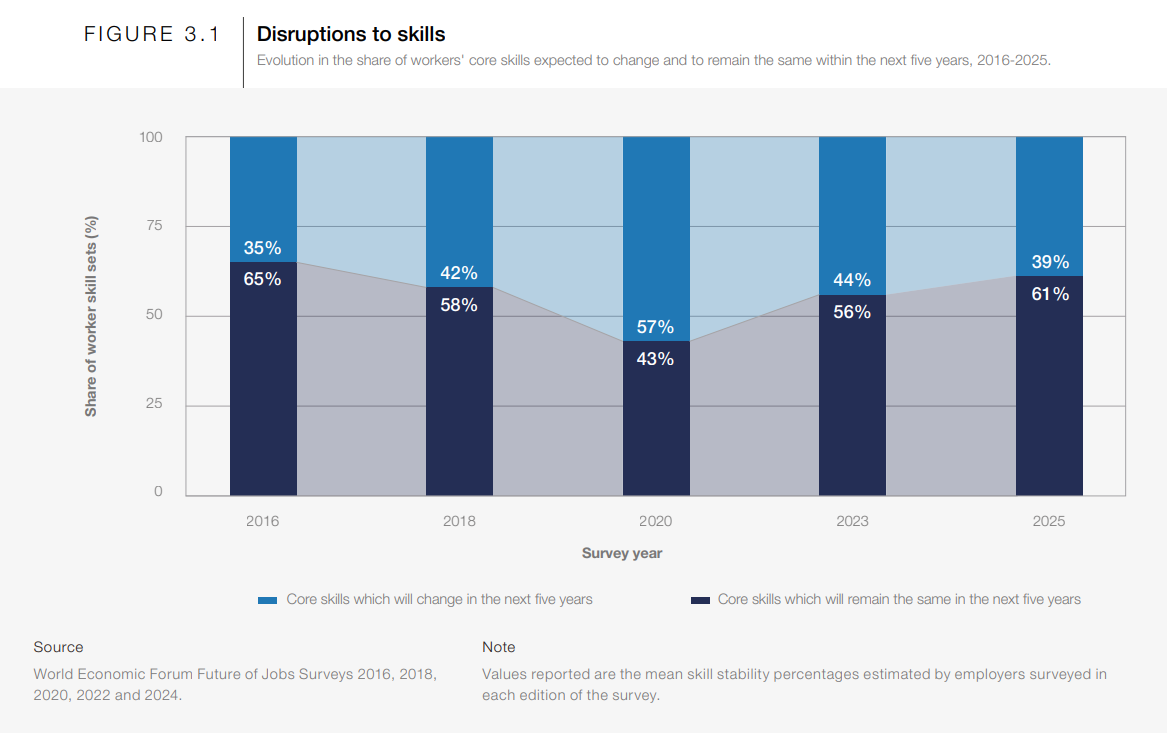
Image from The Future of Jobs Report 2025 by the World Economic Forum
How Skills-Based Hiring Is Reshaping Recruitment Across Industries
The shift away from traditional credentials is a fundamental market correction. Organizations realize that strict educational filters exclude highly capable candidates.
Moving past degree-based hiring
Relying solely on a university diploma arbitrarily screens out millions of workers. In the United States alone, over 70 million people belong to a category known as STARs (Skilled Through Alternative Routes). These individuals developed valuable expertise through military service, community college, or direct on-the-job experience.
When you enforce a strict degree requirement, you actively block half of the workforce from your talent pipeline. Moving past this outdated filter lets you access proven problem-solvers who are fully prepared to contribute.

Public and private sector pivot
Corporate leaders and government agencies are adopting skills-based recruiting to match this reality. Dropping the paper ceiling helps these organizations fill vacancies faster and builds more resilient teams.
- Corporate pioneers: Legacy companies like Walmart, Bank of America, and IBM are removing degree requirements from thousands of job postings. They now prioritize work experience and specific tech certificates to fill critical roles in cybersecurity, data analytics, and operations.
- Public sector overhaul: State governments are making similar moves. States such as Maryland, Pennsylvania, Colorado, and Utah have eliminated bachelor’s degree mandates for the majority of their civil service positions. They recognize that assessing demonstrated competence builds a stronger, more effective workforce.
Implementing Skills-Based Hiring Practices
Transitioning away from conventional recruitment requires a systemic overhaul. You must fundamentally change how you source, screen, and evaluate candidates.
| Feature | Traditional Hiring | Skill-Based Hiring |
| Job Descriptions | Laundry list of credentials | Core competencies required |
| Sourcing | University pipelines | Alternative credential programs |
| Screening | Resume parsing | Pre-employment testing |
4-Step Process to Skills-Based Hiring
- Rewrite job descriptions. Strip out arbitrary educational requirements. Focus entirely on the specific hard and soft competencies necessary for the role.
- Deploy pre-employment testing. Move candidates straight to functional assessments. By 2030, 48% of employers plan to use pre-employment tests, and 34% expect to rely on psychometric profiling.
- Evaluate applied experience. Swap pedigree checks for technical assessments or paid pilot projects. Evaluating actual work experience remains a top priority, with 81% of organizations planning to use this metric in their hiring decisions.
- Train hiring managers. Equip your interviewers to assess behavioral adaptability and problem-solving skills. They need to spot potential and agility rather than resting on the comfort of a familiar university name.
Navigating this operational pivot is complex. Organizations often struggle to build accurate assessment frameworks internally. Partnering with a specialized agency accelerates the transition. As one of the leading recruiting agencies in Salt Lake City, Recruiting Connection modernizes your talent pipelines. We can help you integrate proven skills-based recruiting strategies into your broader search process. This ensures you secure highly capable professionals ready to deliver immediate value, regardless of their traditional credentials.
How Skills-Based Hiring Transforms Workforce Planning
Removing degree requirements changes more than just your immediate recruitment metrics. It forces a strategic shift in how you plan for long-term talent availability.

1. Expanding the funnel to overlooked demographics
Moving away from degree requirements opens your pipeline to historically overlooked talent pools. When you focus on verified capabilities, you can tap into rural workers, military veterans transitioning to civilian life, caregivers returning to the workforce, and older workers with decades of applied experience.
Evaluating candidates based on what they can actually do instantly diversifies your talent pool and brings new problem-solving perspectives to your team.
2. Prioritizing internal mobility and upskilling
Workforce planning must shift from constantly “buying” new talent to “building” it internally. As technological demands shift, employers expect a massive portion of core skills to change in the coming years. Creating robust internal retraining programs ensures your current employees can step into emerging roles rather than becoming obsolete.
3. Building a skill-based hiring culture
To make this transition stick, organizations need to adjust how they manage their people long-term:
- Reward adaptability: Structure performance reviews to prioritize continuous learning and flexibility over tenure alone.
- Map out career paths: Create clear internal mobility pathways where current employees are actively trained for emerging job opportunities without a degree.
- Align compensation: Adjust your pay structures to recognize newly acquired certifications, technical bootcamps, and verified competencies rather than just formal degrees.
Redefining the Perfect Candidate
A college degree is no longer the only reliable indicator of a candidate’s potential. Organizations that broaden their evaluation criteria are finding adaptable, proven problem-solvers who are often filtered out by strict academic requirements. Prioritizing verified capabilities gives you direct access to a wider workforce that’s equipped to deliver results immediately.

Transitioning to this modern recruitment approach takes time, operational alignment, and deep market expertise. At Recruiting Connection, we understand the nuances of building resilient, future-ready teams. As premier professional recruiters in Utah, we partner with organizations to source and vet candidates based on verified capabilities and proven experience.
Whether you need visionary leadership secured by our executive recruiters or strategic talent acquisition leaders sourced through a specialized HR recruiting firm, we tailor our process to find the exact competencies your business demands.
Ready to modernize your talent pipeline and secure the specific skills your team is missing? Contact us today to start the conversation.
New Collar Jobs & Skills-Based Hiring FAQs
What is a new collar job?
A new collar job is a role demanding specialized technical or soft skills. Candidates build these necessary competencies through alternative educational routes, including coding bootcamps, vocational schools, specific industry certificates, and extensive hands-on experience.
Blue collar vs. new collar: What’s the difference?
Historically, blue-collar roles primarily involved physical or manual labor. In contrast, new collar work bridges the historical divide by focusing heavily on technical, digital, and soft skills. While both value hands-on capability, new collar roles typically require continuous technical upskilling.
What are examples of new collar jobs?
Employers actively seek candidates for these positions based on technical proficiency across both emerging and established sectors. High-demand examples include cybersecurity analysts, robotics operators, wind turbine technicians, and medical records technicians.
Why are employers dropping degree requirements?
Five distinct economic and technological pressures force this massive realignment. Employers face soaring tuition costs, rapid workplace automation, shrinking working-age populations, massive federal infrastructure investments, and the fast-changing nature of core technical skills.
How do you implement skill-based hiring?
Transitioning requires a systemic overhaul of how you source and evaluate candidates. Organizations must focus job descriptions on core competencies, deploy pre-employment testing, evaluate applied experience, and train managers to assess behavioral adaptability.
How does skills-based hiring affect workforce planning?
Removing strict educational filters instantly diversifies your talent pool. It forces a strategic shift from constantly acquiring new employees to building robust internal retraining programs so your current team can step into emerging roles.
How do you train for a new collar job?
Candidates build the required competencies through alternative educational routes rather than traditional four-year universities. You can gain these skills by graduating from coding bootcamps, attending vocational schools, or earning specific, industry-recognized certificates. Programs like Google or IBM certificates provide rigorous, job-ready training.
Do new collar jobs pay well?
Yes, many of these positions are highly compensated because they require specialized technical expertise. By removing strict degree filters, companies actively compete for capable professionals in lucrative fields like cybersecurity, cloud architecture, and advanced manufacturing, driving up wages for proven talent.
SHARE



Struggling to find top
talent for your business?
Connect with the expertes at Recruiting Connection and discover the difference our full-service recruitment can make.
Contact Us Today