

50+ AI Job Displacement Statistics: Trends & Hiring Impact (2026)

📝 Key Takeaways
AI job displacement statistics reveal that automation fundamentally reshapes how organizations structure their teams and evaluate potential candidates. While technology absorbs routine workflows, human oversight remains essential.
- Software programs automate specific tasks rather than entire job roles.
- Emerging labor trends create significant shifts in entry-level hiring needs.
- Organizations must transition toward skills-based workforce planning strategies.
- Technology creates new professional tiers to manage automated systems.
Workforce disruption is no longer a theoretical threat for businesses navigating the current labor market. As machine learning algorithms absorb routine workflows, organizations face the immediate challenge of restructuring their headcount to maintain operational efficiency without losing critical expertise.
Software programs are taking over specific administrative and entry-level functions, yet this technological shift simultaneously exposes massive hiring gaps.
Companies now require a new tier of professionals equipped to audit, manage, and govern these complex systems. Identifying exactly where human intervention remains irreplaceable is crucial for long-term stability. But as these tools mature, exactly how many jobs will AI replace?
This article analyzes the latest AI job displacement statistics to provide a practical framework for navigating such structural changes. Discover the specific operational tiers facing disruption, the resulting skills gap, and the new roles necessary for effective workforce planning.
Current Landscape of Workplace Automation (2026)
Business leaders frequently mistake task exposure for inevitable job destruction. However, when a generative model executes a specific function, it signals a shift in daily operations rather than the complete erasure of a role.
This nuance provides a much clearer picture of AI’s actual impact on jobs. The 2026 labor market reveals two distinct paths:
- Task Automation: Algorithms absorb routine, codifiable work. This reduces the time spent on manual data entry or basic research but does not eliminate the need for strategic oversight.
- Role Augmentation: Technology enhances employee capabilities. A significant portion of your workforce will pivot to oversee, audit, and refine machine learning outputs.
Differentiating between augmented tasks and fully automated positions allows companies to pursue strategic realignment.
2026 AI Job Displacement Statistics
The following data points quantify how automation alters the global workforce. Review these figures to understand the reality of AI job loss, the industries facing immediate disruption, and the demographic groups navigating the biggest transitions.
Global and U.S. Exposure
- Roughly 40% of jobs globally face meaningful exposure to AI capabilities. In high-income countries, this figure rises to closer to 60%. (International Monetary Fund)
- By 2030, structural labor-market churn will affect 22% of total jobs globally, resulting in 170 million new jobs created and 92 million displaced (a net growth of 78 million jobs). (World Economic Forum)
- 41% of employers globally plan to reduce their workforce in areas where Al can automate tasks within the next five years. (World Economic Forum)
- Approximately 57% of current U.S. work hours could, in theory, be automated by today’s technology. (McKinsey)
- Al automation will displace roughly 6-7% of the U.S. workforce over the longer term, equivalent to approximately 11 million workers. (Goldman Sachs)
- Around 300 million full-time jobs globally will be affected by generative Al. (Goldman Sachs)
- Approximately 3.9% of U.S. workers—roughly 5 to 6 million people—sit at the intersection of high AI exposure and low adaptive capacity. (National Bureau of Economic Research)
- If current generative AI use cases were expanded across the entire economy today, an estimated 2.5% of U.S. employment would be at immediate risk of displacement. (Goldman Sachs)
- Generative AI is expected to raise U.S. labor productivity by 15% once fully adopted, but it will temporarily increase the unemployment rate by 0.5 percentage points during the transition. (Goldman Sachs)
- While millions face exposure, of the 37.1 million U.S. workers in the top quartile of AI exposure, 26.5 million possess above-median “adaptive capacity,” leaving them well-equipped to handle potential job transitions. (National Bureau of Economic Research)

Pace and timeline of displacement
- Approximately 21,400 job cuts—or 26% of total job cuts—were directly attributed to AI in April 2026. (Challenger, Gray & Christmas)
- AI is the third-leading cause of job cut plans, accounting for 16% of all layoff plans in 2026. (Challenger, Gray & Christmas)
- By 2030, 39% of core job skills will transform or become outdated. (World Economic Forum)
- 59% of workers will need to upskill or reskill by 2030 to remain competitive in their roles. (World Economic Forum)
- AI-exposed roles had not yet experienced significant net job losses relative to other roles between 2014–2023. (MIT Sloan)
- 32% of surveyed organizations predict an enterprise-wide workforce reduction of 3% or more as a direct result of AI implementation. (McKinsey)
- The timeline for major disruption has accelerated to 2027-2028, with 76,440 positions already eliminated during the 2024-2025 early adoption phase alone. (SSRN)
Jobs and Industries Facing the Most Disruption

Administrative and clerical roles
- Approximately 6.1 million U.S. clerical workers are at high risk. (Brookings Institution)
- Manual data-entry roles face an estimated automation risk of 95%. (SSRN)
- 7.5 million data-entry and administrative jobs could be eliminated by 2027. (SSRN)
- Administrative support occupations, which currently employ 17.8 million U.S. workers, face the highest AI exposure rate of any major occupational group. (National Bureau of Economic Research)
Customer service
- Customer service representatives face a 90% automation risk by 2027. (SSRN)
- Customer service representatives are among the 4.2% of the workforce sitting in the critical intersection of high AI exposure and low adaptive capacity. (National Bureau of Economic Research)
- IBM’s internal AI assistant, AskHR, resolves 94% of inquiries without escalation while handling 11.5 million interactions annually. (IBM)
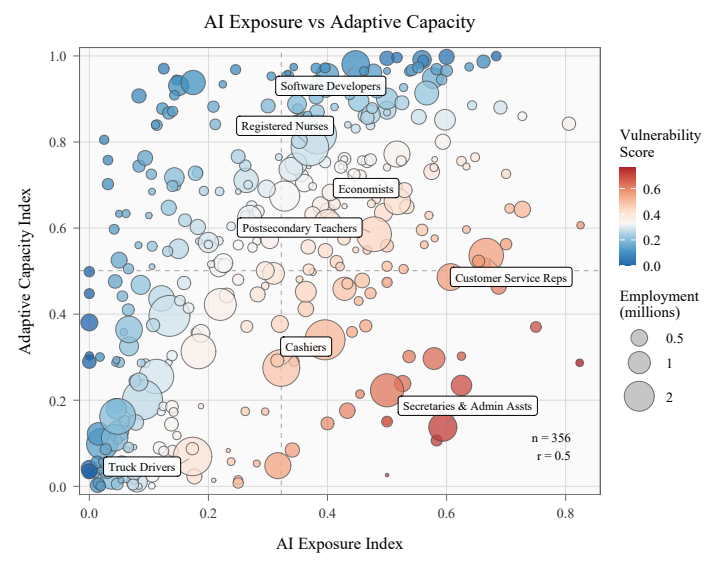
How Adaptable Are American Workers to AI-Induced Job Displacement?, National Bureau of Economic Research
Financial services
- Up to 200,000 roles in financial services could be cut over the next three to five years as banks automate back- and middle-office work. This represents roughly 3% of the sector’s workforce. (Fortune)
- Singapore’s DBS Bank announced plans to cut approximately 4,000 roles over three years. (BBC)
- Employers in the financial services sector anticipate a 97% exposure to AI disruption by 2030, ranking significantly higher than the global average. (World Economic Forum)
Creative, content, and marketing roles
- Demand for writing and translation skills fell 20-50% in AI-substitutable categories on online freelancing platforms. (ScienceDirect)
- Following the public launch of widespread generative AI, the number of job postings in highly substitutable freelance clusters decreased by 24%. (ScienceDirect)
- Content writers face a projected 50% employment reduction by 2030, dropping from 380,000 to 190,000 roles. (SSRN)
- Editors, proofreaders, and advertising copywriters each face projected employment declines of 30%. (SSRN)
- Freelancers in writing roles saw an average 2% monthly job decline and a 5% monthly earnings drop after generative AI tools became widespread. (Brookings)
- While traditional freelance writing jobs declined, demand for AI-powered chatbot development surged by 179%. (ScienceDirect)
Manufacturing and warehousing
- The U.S. has already lost approximately 1.7 million manufacturing jobs to machines since 2000. (Oxford Economics)
- Global manufacturing could lose up to 20 million jobs by 2030 if automation trends continue. (Oxford Economics)
- By 2030, assembly line roles are projected to drop from 2.1 million to roughly 1.0 million, and packaging workers from 890,000 to 320,000. (Deloitte)
- AI and information processing technologies are expected to drive business transformation in 81% of advanced manufacturing organizations between 2025 and 2030. (World Economic Forum)
Transportation and logistics
- In the supply chain and transportation sector, 86% of employers expect AI and information processing technologies to drive organizational transformation by 2030. (World Economic Forum)
- 1.5 million U.S. trucking jobs are at risk by 2030. (SSRN)
- Professional driver employment is projected to fall from 3.8 million in 2024 to approximately 2.3 million by decade’s end. (SSRN)
- Logistics robot installations have surged rapidly, with annual sales reaching approximately $2.4 billion, and 90% of these new systems are being installed outside of traditional factory settings. (Oxford Economics)
Retail
- The U.S. retail sector employs about 16 million workers—including cashiers, stock clerks, and salespeople—who are increasingly facing displacement as robotics expand from giant warehouses to the retail floor. (Oxford Economics)
- Cashiers are increasingly flagged as highly vulnerable, representing occupations with both top-quartile AI exposure and bottom-quartile adaptive capacity. (National Bureau of Economic Research)
- Alongside cashiers, material-recording and stock-keeping clerks rank among the top five declining job categories globally for the 2025-2030 period. (World Economic Forum)
Demographics

Young workers and entry-level positions
- Among 22-25-year-olds in AI-exposed roles, employment fell 16% from late 2022 to mid-2025. Among young software developers specifically, the decline was nearly 20%. (Stanford University)
- Occupations with higher AI exposure saw larger unemployment rate increases between 2022 and 2025. (Federal Reserve Bank of St. Louis)
- Postings for entry-level jobs overall had declined approximately 35% since January 2023. (Revelio Labs via CNBC)
- AI could eliminate roughly 50% of white-collar entry-level positions within five years. (Axios)
- 59% of 18-29-year-olds see AI as a threat to future job prospects. (Harvard Kennedy School)
Women and gender disparity
- 16% of female-dominated occupations are categorized as high-risk for automation, compared to 3% of men. (International Labour Organization)
- Employed women are nearly twice as likely as men to be in jobs at high risk of automation, representing 65 million highly exposed female workers compared to 51 million male workers globally. (United Nations)
- Globally, 4.7% of women’s jobs face high AI disruption risk compared to 2.4% for men. In high-income countries, the disparity is starker: 9.6% of women’s jobs are at top AI risk versus 3.2% of men’s. (United Nations)
- Although AI is driving rapid job growth in tech-intensive sectors, women represent only 30% of the global AI workforce, risking the perpetuation of gender biases. (United Nations)
Geography and regional variation
- 2.4%–6.9% of workers in any given metropolitan and micropolitan area sit in high-exposure, low-adaptability roles, with a national average of 3.9%. (National Bureau of Economic Research)
- AI could affect close to 60% of jobs in advanced economies, compared with 40% in emerging markets and 26% in low-income countries. (International Monetary Fund)
Restructuring your headcount requires a partner who understands the local talent pool. As one of the leading recruiting firms in Salt Lake City, Recruiting Connection applies over 90 years of shared experience and precise vetting to secure highly qualified professionals. We’ll serve as your dedicated HR recruiting firm to source leaders who can manage complex workforce transitions, ensuring your team adapts quickly to these market shifts.
5 Key Job Displacement Trends Reshaping the Hiring Landscape
Tracking raw data reveals the sheer scale of workforce disruption, but analyzing the underlying trends demonstrates exactly how recruitment strategies are shifting. Rather than simply eliminating headcount, automation fundamentally alters the types of candidates organizations target. Here are ways machine learning currently dictates corporate hiring pipelines.

1. Contraction in entry-level and junior opportunities
Assigning routine administrative work to new graduates used to be the standard way to build a talent pipeline. Algorithms now handle those foundational tasks, creating a significant bottleneck for early-career professionals.
Because businesses use software to bypass the apprentice phase entirely, the decline in junior employment stems from stagnant hiring rather than mass layoffs. While this boosts immediate efficiency, it threatens to spark a “talent doom cycle” that cuts off the training ground for future leadership.
2. Hiring shifts favoring tacit over codified knowledge
Technology easily replicates textbook information, yet it struggles to replace complex problem-solving and unspoken company wisdom. This capability gap creates a sharp divide in labor demand.

Programs absorb the routine cognitive tasks of novice employees while actively augmenting the experiential, tacit knowledge brought by veteran staff. Consequently, retention for older professionals remains remarkably robust.
Occupations that heavily reward hands-on experience are seeing increased wage growth as these tools amplify the productivity of seasoned experts.
3. Net employment growth within AI-adopting firms
The efficiency gains generated by artificial intelligence prompt executives to deliberately slow hiring for back-office and operational roles. However, this direct downsizing masks a broader reality.
Organizations that implement these tools most effectively tend to hire more workers overall. Substituting human labor at the task level unlocks immense productivity and profitability gains, which fuels broader company expansion.
Even as specific routines become automated, the workforce at these highly productive firms frequently expands to support new strategic initiatives.

4. Surging demand for AI specialists amid educational roadblocks
Traditional white-collar recruitment has slowed, yet the demand for professionals capable of building and managing advanced systems is skyrocketing. Filling these roles proves difficult due to massive educational barriers, which prevent displaced workers from easily transitioning into open tech positions.
To bypass this obstacle, employers are actively modifying recruitment strategies to prioritize skills-based hiring. The focus has shifted toward securing candidates with uniquely human traits (such as resilience, adaptability, and creative leadership) that software cannot readily replicate.
5. Rapid skill leveling across the freelance market
Operating on flexible, short-term contracts allows the gig economy to serve as a rapid indicator for broader corporate displacement trends. Following the widespread adoption of advanced models, hiring for short-term freelance contracts in text-heavy fields plummeted.
Surprisingly, this contraction heavily penalized top-tier experts. Algorithms enable novice workers to generate outputs that approximate expert quality, effectively leveling the playing field.
Clients are no longer willing to pay premium rates for highly experienced gig workers when software provides a comparable baseline.

The Human Advantage
The transformation sweeping through the labor market proves that the future belongs to companies that can balance algorithmic efficiency with human insight. While operational parameters shift, the demand for strategic leadership and complex problem-solving remains constant. Today’s true competitive advantage stems from positioning the right people to guide these systems.
Securing specialized talent requires localized expertise to find agile leaders capable of overseeing automated workflows. If you’re looking to conduct an executive search in Utah, Recruiting Connection provides the rigorous vetting and deep talent networks necessary to fulfill these complex placements. Our professional recruiters in Salt Lake City can connect your organization with the precise candidates needed to drive sustainable business growth.
Contact our team today to strengthen your hiring pipeline for the future!
AI Job Displacement FAQs
How many jobs will AI replace by 2030?
Recent data suggests that the amount of jobs AI will replace varies by region, with roughly 92 million roles facing displacement globally. However, this shift should create a net gain of 78 million new positions as industries adapt to automated workflows.
Which industries face the most AI job loss?
The highest rates of AI job loss occur in administrative support, customer service, and manufacturing. These sectors rely heavily on routine, codifiable tasks that machine learning algorithms can now execute with high precision and lower costs.
What is AI’s true impact on jobs today?
AI’s current impact on jobs focuses more on task automation than total role erasure. Most professionals find their daily responsibilities shifting toward system oversight, auditing machine outputs, and managing complex problem-solving that software cannot yet replicate.
Are jobs replaced by AI being recovered elsewhere?
While many traditional jobs replaced by AI are declining, demand is surging for specialists who can govern these technologies. Highly productive firms using automation often expand their total headcount to support new strategic initiatives and business growth.
Who is most vulnerable to AI job displacement?
Current AI job displacement statistics show that entry-level workers and those in high-exposure clerical roles face the most immediate risk. Women are also statistically more likely to hold positions categorized as high-risk for automation compared to men.
SHARE



Struggling to find top
talent for your business?
Connect with the expertes at Recruiting Connection and discover the difference our full-service recruitment can make.
Contact Us Today