

AI in Recruitment (2026): Trends, Tools, and Hiring Impact

📝 Key Takeaways
AI recruitment transforms how businesses hire by automating repetitive tasks and finding candidates faster. This shift lets recruiters focus on building relationships and making decisions.
- Automated systems now manage hiring processes from start to finish.
- Helpful tools handle resume screening, scheduling, and outreach to save time.
- Businesses must audit these tools to prevent unfair hiring practices.
- Human judgment remains essential for assessing culture fit and securing offers.
With roughly 87% of companies now utilizing intelligent systems, artificial intelligence has clearly moved past the experimental phase to become a structural reality in hiring. In fact, AI in talent acquisition stands as the most common application for the technology across human resources. The corporate conversation has consequently shifted; leadership teams no longer debate the basic merits of automation, focusing instead on how to integrate these layers responsibly.
These systems don’t exist to replace human recruiters, though. Instead, they serve as practical mechanisms for managing scale and administrative complexity, transforming what used to be a manual, bottleneck-heavy screening operation into a data-driven discipline.
By removing friction and data noise, tools like AI recruitment software help hiring teams handle massive applicant pools without drowning in paperwork.
This guide explores the strategic evolution reshaping the modern workforce. We break down the top trends defining AI in recruitment, examine essential tool categories, and analyze the dual-sided impact on current hiring practices to provide a clear roadmap for organizations.
The Role of AI in Talent Acquisition: An Overview
Modern hiring frameworks deploy AI as an efficiency and decision-support layer rather than an ultimate decision-maker. Businesses routinely face an overwhelming volume of rules-based tasks—processing thousands of resumes, coordinating complex interview schedules, and pushing out status updates.

These administrative chores consume massive amounts of time but rarely require nuanced human judgment. Offloading these repetitive burdens to smart software helps organizations establish a much more responsive workflow.
This shift fundamentally targets the “coordination tax“—the hours HR professionals lose while manually managing handoffs between disconnected platforms. When automated systems bridge these data silos, corporate recruiting teams often recapture up to 60% of their working hours.
The technology manages scale and filters out data noise, allowing human professionals to focus their energy where it matters most. Recruiters pivot toward high-value activities like assessing corporate cultural alignment, building deep talent relationships, and securing critical offers.
What is AI Recruitment?
AI recruitment utilizes smart software to automatically manage the entire hiring process from start to finish. Rather than relying on separate AI and recruiting tools for different tasks, it connects every step into one seamless system. This distinction matters because it highlights how modern teams actually work, eliminating the need to constantly switch between disconnected apps.

Three core technological engines drive this unified system:
- Machine learning and predictive analytics: Machine learning models identify intricate data patterns over time to power deep contextual semantic searches. Rather than using superficial keyword matching, the system understands the underlying meaning of a candidate’s experience. Predictive analytics then process these insights to forecast broader workforce trends and evaluate retention likelihoods.
- Generative AI: This layer specializes in synthesizing and producing text. It generates inclusive job postings, creates highly tailored outreach messages based on a candidate’s specific career history, and builds structured interview summaries for hiring panels.
- Agentic process automation (APA): The modern benchmark for automation involves digital agents capable of understanding intent and independently managing multi-step workflows across different HR platforms. An autonomous agent can source candidates, screen profiles against evolving performance criteria, and trigger immediate onboarding steps like background checks without requiring manual human prompting at every stage.
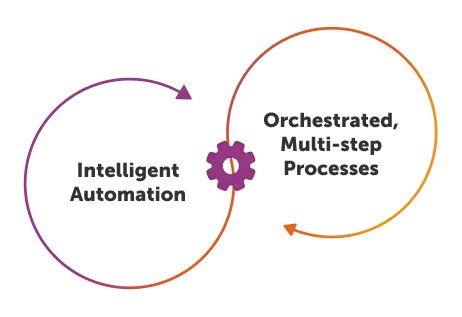
Image via Automation Anywhere
5 Key AI Recruiting Trends (2026)
Talent acquisition has moved past haphazard technology adoption, shifting toward deliberate, data-backed design. Here are the developments currently reshaping how companies find and secure talent.
1. Rise of agentic AI and workflow orchestration
Instead of waiting for a human to click a button, autonomous digital agents manage candidate pipelines from start to finish. These systems source talent, parse resumes, and update tracking platforms entirely in the background. With software usage across HR tasks climbing to 43%, the impact on daily workloads is hard to ignore.
Handing these duties over saves recruiters an average of 4.5 hours a week on candidate searches and another 3.6 hours on administrative work. Consequently, time-to-hire drops, forcing hiring professionals to evolve into strategic orchestrators who focus on relationship-building rather than data entry.

As automation changes daily operational workloads, see how technology is shifting broader employment trends in our guide: 50+ AI Job Displacement Statistics: Trends & Hiring Impact
2. Authenticity dilemma and AI-powered verification
Generative technology has compromised traditional screening funnels. Because applicants can instantly produce flawlessly tailored resumes or rely on real-time scripting overlays during video interviews, the line between an authentic candidate and a fabricated persona is constantly blurring.
An estimated 40% to 80% of job seekers now use artificial intelligence for application prep. This widespread usage makes it difficult to trust traditional signals, leading experts to anticipate that one in four candidate profiles will be partially or entirely fake by 2028.
While the majority of executives worry about data accuracy, only 5% report making actual progress. Organizations counter this rampant fraud by deploying identity verification and behavioral analytics, utilizing liveness detection to confirm actual competence.

3. Shift to adaptive, reasoning-based interviews
Standard behavioral questions fail when applicants use live digital assistants. Studies analyzing recorded interviews uncovered suspicious patterns suggesting real-time software assistance in nearly 40% of mid-level technical interviews and 60% of new graduate software engineering assessments.
Employers now favor adaptive, reasoning-first assessments as a necessary defensive measure. Dynamic interviews throw candidates into unfamiliar scenarios mid-conversation, forcing them to defend complex trade-offs. This approach tests the kind of lateral thinking that live-scripting software simply cannot fake. When utilizing these unscripted interviews, roughly one in four candidates actually outperforms what employers originally expected based on their resumes.
4. Strict regulatory compliance and explainable AI
Legal and ethical scrutiny intensifies as these systems scale. Hence, stringent compliance mandates turn algorithmic governance into a strict operational requirement. Regulations like the EU AI Act and various US state laws legally require companies to guarantee human oversight.
Using AI in recruitment demands explainable models and robust governance to prevent a risky environment of unmonitored technology. Without clear, enforceable guardrails, organizations expose themselves to data leakage, regulatory violations, and dangerous false confidence in automated decisions.
A massive operational disconnect currently complicates this issue. While hiring regulations strictly mandate human oversight, Ivanti’s 2026 State of Cybersecurity Report reveals that 77% of technical professionals are actually comfortable allowing autonomous AI systems to act without human review.
To safely scale recruitment automation and bridge this compliance gap, HR teams must establish comprehensive AI guardrails. Data shows that organizations with advanced security maturity are nearly three times as likely to enforce these critical frameworks to maintain candidate trust and legal compliance.
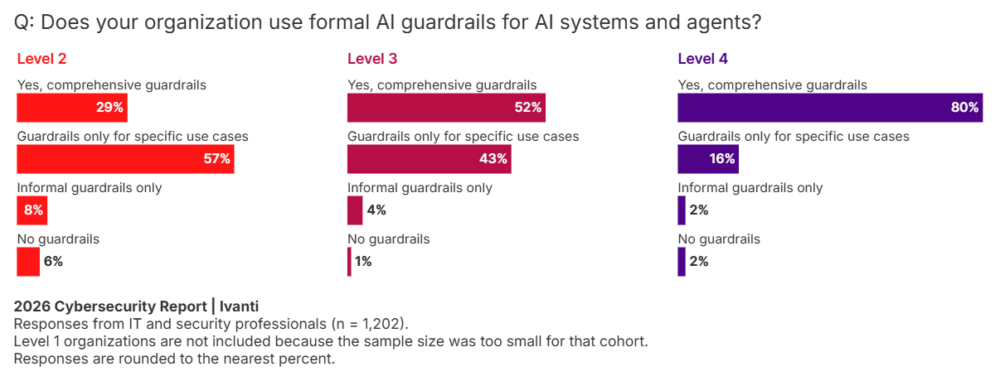
Image via Ivanti
5. Smart high-volume hiring and internal mobility
Recruiting automation tools completely transform how organizations manage high-turnover roles. Candidates apply, interact with intelligent chat screenings, and schedule interviews autonomously in minutes.
Eliminating manual bottlenecks like initial resume reviews and calendar coordination allows these platforms to reduce time-to-hire by 75%. Conversational software also provides continuous candidate support, lowering drop-off rates by up to 40%. This minimizes delays and keeps the entire hiring process moving smoothly.
Simultaneously, machine learning maps the skills of the current workforce to recommend existing staff for internal mobility. Organizations also blend recruitment marketing with organic employee advocacy. Authentic storytelling matters—companies with socially engaged employees are 58% more likely to attract top talent. Furthermore, 20% are more likely to retain them, potentially reducing overall turnover by nearly 28%.

While the hiring landscape grows increasingly complex, evaluating a candidate’s true capability still relies on human intuition and industry insight. Partnering with professional recruiters allows you to bypass the flood of generic resume submissions. As an experienced HR recruitment company, Recruiting Connection relies on rigorous behavioral interviews and localized market expertise to verify real competence. We evaluate the actual performance history, communication skills, and workplace motivations that software cannot accurately measure.
Essential AI Recruiting Tools
AI recruitment software has now evolved into comprehensive engines driving the hiring process. When evaluating the best AI recruiting tools for your team, mapping them to specific pipeline bottlenecks clarifies their value. The table below breaks down the primary types of technology currently shaping the industry:
| Tool category | Core function | Notable examples |
| Sourcing and discovery platforms | Locates passive talent across the open web using natural language search and semantic analysis. Infers transferable skills and forecasts a candidate’s readiness to change jobs. | SeekOut, Juicebox, HireEZ |
| Intelligent screening and parsing | Automatically extracts structured data from applications. Ranks candidates based on role requirements and capabilities rather than pedigree. | SmartRecruiters, Skima |
| Conversational AI and scheduling bots | AI that acts as a digital assistant for recruiters. Manages personalized outreach, answers candidate questions, and coordinates complex interview logistics autonomously. | Paradox, CloudTalk |
| Interviewing and assessment platforms | Facilitates on-demand video evaluations. Assesses candidates against role-related competencies using structured scoring. Generates structured interview notes for human reviewers. | HireVue, Metaview |
| Generative AI for recruitment marketing | Drafts job postings, outreach sequences, and interview questions. Analyzes descriptions to highlight biased language and scores posts based on their appeal to diverse candidates. | Textio, Claude |
| Agentic AI and workflow orchestrators | Independently manages multi-step workflows. Identifies candidates, drafts contextual submission emails, and triggers background checks. Acts as the connective tissue between fragmented HR systems. | Recruiterflow, Joveo |
Using AI in Recruiting: How It Can Impact Hiring
Integrating AI delivers profound impacts on operational efficiency while introducing entirely new vulnerabilities. Understand how these tools reshape the pipeline, adapt your approach, and secure top candidates.
Accelerated hiring velocity and reduced costs
Automation strips away administrative bottlenecks. Implementing an intelligent platform often results in a 43% faster time-to-shortlist and a 14% reduction in the average cost-per-hire.
Strategy: Establish baseline metrics and don’t automate the entire funnel at once. Many organizations cannot calculate their return on investment because they failed to establish baselines first. Identify your highest-friction bottlenecks and measure current time-to-hire before deploying recruitment automation solutions.
2. Authenticity crisis and diluted talent density
Traditional screening signals lose their value when applicants easily mass-produce flawless resumes or use real-time scripting tools. Relying entirely on automated filters risks systematically selecting candidates who game the hiring process rather than those actually equipped to do the job.
Strategy: Shift to adaptive assessments. Digital assistants easily script standard behavioral questions. Introduce dynamic friction by throwing candidates into unfamiliar scenarios mid-conversation. Providing flawed, AI-generated business plans or code snippets for candidates to evaluate tests genuine judgment and lateral thinking.

3. Institutionalized algorithmic bias
Models trained on historical data can institutionalize past biases. They might systematically filter out exceptional but unconventional talent because the individual lacks traditional markers.
Strategy: Mandate continuous bias audits. Algorithmic governance constitutes a strict legal liability, so treat vendor algorithms as an internal responsibility. If a third-party tool discriminates, your organization bears the legal consequences.
4. Diminished candidate trust
Candidate trust remains remarkably low—only 26% of applicants trust algorithms to evaluate them fairly. Many highly qualified professionals abandon applications upon realizing a machine solely evaluates their potential.
Strategy: Be fully transparent about where AI use occurs. Explicitly reassure candidates that a human being makes the final decision to maintain goodwill and preserve your employer brand.
5. Elevated importance of the human recruiter
Instead of replacing HR teams, technology elevates their responsibilities. When software handles the administrative burden, recruiters must pivot to assessing cultural fit, managing competing offer conversations, and reading nuanced emotional signals.
Strategy: Implement strict human-in-the-loop oversight. Never abdicate final hiring decisions to an algorithm. Especially in executive search, human intuition remains absolutely irreplaceable for securing top-tier leadership.
The Next Era of Talent Acquisition
AI effectively manages the crushing scale of modern talent acquisition, but it cannot replicate genuine human intuition. Organizations thriving right now deploy automated systems to clear administrative roadblocks, intentionally preserving personal interaction for critical evaluation phases. Speed matters significantly. Securing top-tier professionals, however, still relies entirely on authentic relationship building and nuanced judgment.

Adapting your strategy to these rapid technological shifts requires an experienced partner. As one of the premier recruiting agencies in Salt Lake City, Recruiting Connection pairs data-driven sourcing with deep industry expertise to locate candidates who truly fit your culture.
Whether your business requires precise executive recruiters to secure crucial leadership roles or a dedicated HR recruiting firm to expand your internal capabilities, our team delivers results without relying on blind algorithms.
Contact our team today to find exactly who you need to move your business forward!
AI in Recruitment: FAQs
What is AI recruitment?
AI recruitment uses smart software to automate the hiring process from start to finish. Instead of relying on disconnected applications, it connects tasks like candidate sourcing, resume screening, and interview scheduling into one seamless system to save time and reduce manual administrative burdens.
How is AI changing the hiring process?
Artificial intelligence transforms hiring by accelerating screening, improving candidate matching, and automating repetitive tasks like interview scheduling. Recent trends also highlight the use of adaptive video interviews and strict continuous bias audits to ensure fairness while managing massive applicant volumes.
What are the best AI recruiting tools?
The most effective AI recruitment software depends on your pipeline bottlenecks. Key categories include:
- Sourcing platforms for finding passive talent.
- Intelligent resume parsers for candidate screening.
- Conversational chatbots for automated scheduling.
- Agentic AI orchestrators for end-to-end workflow management.
Does AI in hiring reduce bias?
AI can minimize human inconsistency, but it risks institutionalizing past prejudices if trained on flawed historical hiring data. To ensure fair hiring practices, companies must mandate continuous algorithmic bias audits, prioritize transparency, and maintain strict human oversight in all final decisions.
Will AI replace human recruiters?
No, artificial intelligence will not replace human recruiters. While technology handles high-volume administrative tasks and initial applicant screening, human judgment remains absolutely essential for assessing corporate cultural fit, managing complex offer negotiations, and building authentic relationships with top-tier candidates.
SHARE


Struggling to find top
talent for your business?
Connect with the expertes at Recruiting Connection and discover the difference our full-service recruitment can make.
Contact Us Today