

The Latest Tech Hiring Trends, Challenges, and Opportunities

📝 Key Takeaways
Tech hiring trends in 2027 point to a selective market: demand is growing outside the tech sector, and AI skills are reshaping what employers ask for.
- Tech job growth now comes from banks, manufacturers, and insurers
- AI skills dominate postings and push pay benchmarks higher
- Postings list fewer skills but demand more years of experience
- Entry-level hiring has shrunk while employers upskill existing staff
Tech hiring picked up in 2026, but not evenly. Employers posted more technical roles in September than in any month in three years, while the technology sector itself kept cutting staff. The growth came from banks, insurers, manufacturers, and consultancies building their own engineering teams.
That shift changes who you’re bidding against. A company hiring a backend engineer in Salt Lake County is competing with a fintech firm in Lehi and a manufacturer in Ogden as much as with a software company.
The other change is what postings ask for. Roles have narrowed to specific capabilities, experience requirements have crept up, and AI skills have spread from specialist titles into ordinary engineering, data, and infrastructure descriptions. That spread carries a wage premium most 2025 budgets didn’t anticipate.
This guide covers the tech hiring trends shaping 2027, the challenges they create for employers, and where the current market works in your favor.
What Are the Key Tech Hiring Trends in 2027?
1. Demand is rebounding, but the growth is narrow
Tech hiring has recovered from its 2025 floor. Employers posted 272,040 new openings for IT occupations in September 2026, up 16% year over year, with active postings up 22.4%, which CompTIA called a three-year high. Dice’s data shows the same direction, with postings up 17% year over year and 9% month over month in September.
The catch is where that demand sits. Employment in the technology sector itself declined by an estimated 10,350 positions in September even as tech occupations grew across the broader economy. Dice found growth concentrated in insurance, consulting, and manufacturing rather than in tech companies.
For employers outside the tech sector, the practical result is a wider competitive set. You’re bidding for engineers against banks, manufacturers, and insurers as much as against software firms.
2. AI skills have moved from specialty to baseline
The clearest signal in the data is how fast AI requirements have spread. Active US postings requiring AI-related skills reached 349,821 in September 2026, an increase of roughly 282% since May 2024.
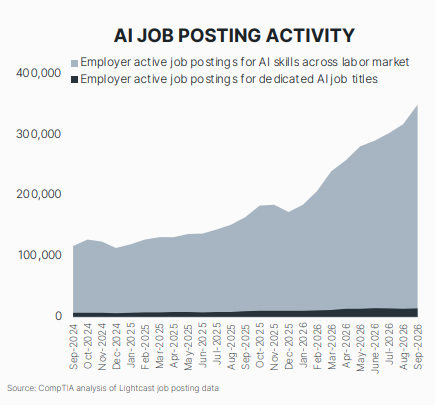
Growth in AI-specific roles outpaces the rest of the market by a wide margin. AI and machine learning postings grew 88% year over year in September, about five times the 17% growth for tech postings overall.
Most of that demand covers deploying and integrating AI into existing systems, so the requirement shows up inside software engineering, data, and infrastructure postings instead of in a separate job family.
3. AI is creating more tech roles than it eliminates
Hiring leaders report net gains. The Linux Foundation’s 2026 State of Tech Talent Report, based on 400 global hiring and training leaders, found organizations reporting a net hiring effect of 26% for 2025 and projecting 31% for 2026, with AI-specific roles at 60%.
The same report found 97% of organizations plan to implement AI, with security and privacy concerns now the leading barrier, up from 17% in 2024 to 48% in 2026. That shift is itself a hiring driver, since securing and operationalizing AI takes people.
4. Entry-level hiring is the exception
Junior roles have not recovered with the rest of the market. Revelio Labs data shows US entry-level postings have fallen about 35% since early 2023.
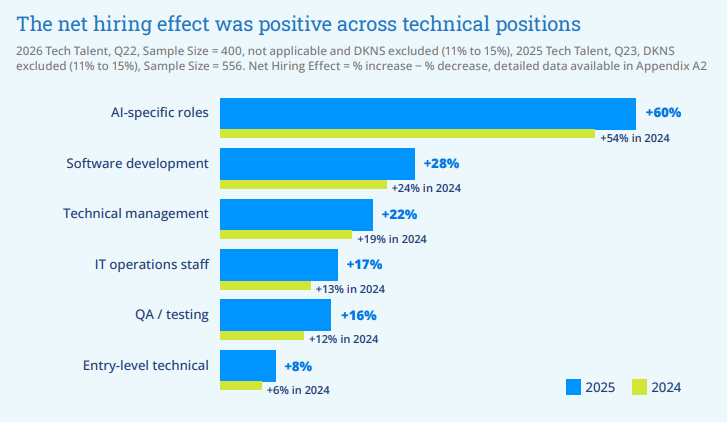
The Linux Foundation found entry-level IT roles growing, but at a net hiring effect of just 8%, far below the 31% for tech hiring overall. For employers, that means a deep applicant pool at the junior end, where screening takes more effort than sourcing.
5. Postings ask for fewer skills and more experience
Job requirements are narrowing and deepening at the same time. Across 75 million tech postings, Revelio Labs found the average skill count fell about 25%, from 30 to 21, since 2024, while required years of experience rose about 4%.
Generalist language is disappearing too. General calls for software development appeared in 16.5% of tech postings in 2026, down from 25.4% in 2023, replaced by specific capabilities. Demands for data organization and research skills now ask for an average of five years of experience, up from two in 2023.
Tighter roles are harder to fill, and they raise the cost of a vague job description. Among current hiring trends in technology, this one has the most direct effect on time-to-fill, and it’s part of why more companies have shifted toward skills-based hiring and away from credential screens.
6. AI experience carries a measurable pay premium
PwC’s 2026 Global AI Jobs Barometer, analyzing job ads across 27 countries, puts the wage premium for AI skills at 62%, up from 57% the year before and 25% two years ago.
Budgets set against last year’s benchmarks will lose candidates who have that experience, and the gap usually surfaces late in a search, when an offer that looked competitive gets matched elsewhere.
7. Employers are training before they hire
Faced with those premiums and a narrow specialist pool, organizations are building capability internally. The Linux Foundation found 57% of organizations upskilling existing staff as their primary response to talent gaps, against 49% hiring new technical staff, with 94% rating upskilling as important.
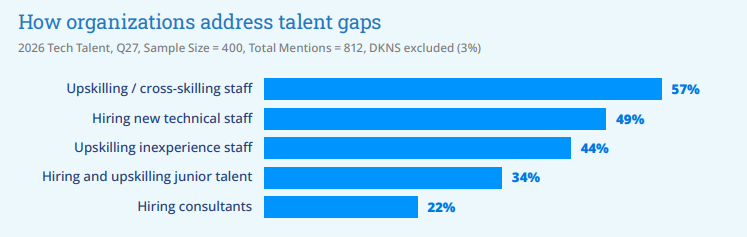
Two figures explain the shift: new external hires take 53% longer to reach productivity, and 28% resign within six months. The World Economic Forum projects that 39% of the core skills the job market requires will change between 2025 and 2030.
External hiring continues alongside it, concentrated on the senior and specialized roles where the gap is too wide to train across. That’s where most searches now sit.
8. Tech talent is concentrating in new places
The geography of tech hiring shifted this year. CBRE’s 13th annual Scoring Tech Talent report found New York Metro reached 394,300 tech talent jobs, passing the San Francisco Bay Area’s 375,730 for the first time. New York added 30,640 tech workers between 2022 and 2025 while the Bay Area contracted by 23,900.
AI drove the swing in both directions, with finance firms hiring AI talent in New York while Bay Area tech companies cut non-AI staff. Across the US and Canada, the AI-skilled workforce grew 45% year over year to 751,000 as of mid-2026, and four metros hold 37% of all US AI-specialty talent.
For employers outside those hubs, two things follow. Non-AI tech postings have fallen sharply nationwide, so experienced generalists are more available than they were two years ago. And anyone on your team with genuine AI experience is being recruited by firms in markets that pay on a different scale.

9. Cybersecurity shortages come down to skills
Security teams report that finding the right capabilities is harder than adding people. In ISC2’s 2025 Cybersecurity Workforce Study of more than 16,000 professionals, 59% reported critical or significant skills needs, up from 44% in 2024. AI (41%) and cloud security (36%) topped the list of shortages.
ISC2 dropped its long-running workforce gap estimate this year specifically because respondents ranked skills above headcount as the bigger problem. The Linux Foundation found the same from the employer side, with 57% of organizations reporting capability gaps in AI security and risk management.
10. Contract and project-based hiring is picking up
Employers are filling more roles on a temporary or project basis rather than adding permanent headcount. Temporary help services employment reached 2,519,500 jobs in August 2026, up 36,200 over the year, according to BLS Current Employment Statistics, and it has risen in every month of 2026 after bottoming out in December 2025.
That matters because permanent hiring hasn’t moved in step. When contingent employment climbs while payroll growth stays flat, the usual explanation is substitution: a role that would have been a full-time hire two years ago becomes a twelve-month contract, because hiring freezes typically apply to headcount rather than to project budgets.
For tech specifically, the appeal is skill risk. When a platform or toolset may be obsolete in three years, a contract engagement provides access to a capability without a permanent commitment. That’s especially true for AI implementation work, where the premiums are steep and the long-term shape of the role isn’t settled.

The trade-off sits in institutional knowledge. Contract engagements buy speed and flexibility, while the people who understand your core systems walk out the door at the end of the term. Teams that staff core platforms this way usually pay for it later.
Most companies land on the same split: contract for defined projects and surge capacity, permanent for anything that becomes part of how the business runs.
Tech Hiring Challenges and Opportunities
The same market conditions create both. Which side of these technology hiring trends you land on depends on what you’re hiring for.

The Challenges
1. You’re competing outside your own industry
Tech occupations are growing across the economy while tech companies themselves shed staff. A manufacturer, a bank, and a software firm are now bidding for the same engineer, and each brings different compensation structures and expectations to the table.
That widens the competitive set in a way most job descriptions haven’t caught up with. If your posting positions the role against other companies in your industry, it’s aimed at the wrong comparison.
2. AI premiums have broken last year’s budgets
A 62% wage premium for AI skills is not something a standard annual adjustment absorbs. The gap usually appears late, when a candidate who seemed closable takes a counteroffer or a competing offer that your range couldn’t meet.
The harder version of this problem is internal. The premium applies to people already on your team who have picked up AI experience, and they’re being recruited by firms in markets that pay on a different scale, which makes retaining your high performers a compensation question before it becomes a hiring one.
3. Narrow roles take longer to fill
Postings now carry fewer skills and more required experience. That’s a rational response to specialization, but it shrinks the qualified pool for every search.
A role defined tightly enough to be useful may have only a few dozen qualified candidates in the state, most of them employed. That’s a sourcing problem, and posting the role longer won’t solve it.
4. Screening volume keeps climbing
The applicant pool at the junior end is deep, and AI-assisted applications have pushed volume higher still. That’s one of the recruitment technology trends working against employers right now: more applications per role adds hours spent separating qualified candidates from the rest.
For teams without dedicated recruiting support, that cost lands on hiring managers who have other jobs to do.
The Opportunities
1. Experienced generalists are more available than they were
Non-AI tech postings have fallen sharply nationwide, and layoffs at large tech companies have put experienced engineers into the market who weren’t available two years ago. For employers who need solid platform, infrastructure, or application engineers instead of AI specialists, this is a better hiring market than 2022 was.

2. Entry-level talent is abundant and underused
Junior hiring has contracted across the industry, so strong early-career candidates are competing for fewer roles. An employer willing to train has leverage here, particularly against competitors who have frozen junior hiring entirely.
The Linux Foundation’s finding that upskilling now outpaces external hiring as the primary response to talent gaps points in the same direction: building capability internally is often faster than finding it outside.
3. Geography is less of a constraint than it was
The talent concentrations are shifting, and the companies that dominate their local markets no longer absorb everyone. Employers outside the major hubs can compete on things the hubs can’t offer: scope, visibility, proximity to decision-makers, and a cost of living that makes a lower nominal salary go further.
4. Contract engagements de-risk uncertain roles
When a capability is expensive and its long-term shape is unsettled, a defined-term engagement lets you move without committing permanent headcount. Rising temporary employment suggests more companies are taking this route, and it works best on discrete projects.
5. Certifications have become a usable screening signal
As specific skills replace broad categories in job requirements, verified credentials carry more weight. Hiring managers now rate certifications above degrees for evaluating technical capability, which widens the pool to candidates who took a non-traditional route.
What This Means for Your Next Search
The split running through all of this is between roles you can fill from the market and roles you have to go find. Junior and generalist positions draw applicants, and the work there is screening well and training quickly. Senior, specialized, and AI-adjacent roles take a different approach, since those candidates are employed and weighing several offers at once.

Recruiting Connection works with employers of the second kind. As a Salt Lake City–based tech recruiting firm, we identify and approach engineers and technical leaders who aren’t on the job boards, then handle screening so your team sees qualified finalists rather than application volume. For CTO, VP of Engineering, and other leadership hires, our executive recruiters run the search from role definition through offer.
Contact our team today to start your next technical search.
Tech Hiring Trends: FAQs
What tech jobs are most in demand in 2027?
AI and machine learning roles are the fastest growing, with postings up 88% year over year in September 2026. Demand is also strong for software engineers, data professionals, and infrastructure specialists who can deploy and integrate AI into existing systems across banking, insurance, and manufacturing.
What are the biggest tech hiring challenges for employers in 2027?
The biggest tech hiring challenges in 2027 include competing against banks and manufacturers for the same engineers, a 62% wage premium for AI skills that breaks existing salary budgets, narrower roles that shrink the qualified candidate pool, and high application volume at the junior level that increases screening costs.
How is AI impacting software engineering and coding jobs?
AI is adding more tech roles than it eliminates, with organizations reporting a net hiring effect of 26% in 2025. AI requirements now appear in standard software engineering and infrastructure postings alongside specialist roles, and they carry a 62% wage premium over positions that don’t require AI skills.
What are the latest tech hiring statistics employers should know?
Employers posted 272,040 new IT openings in September 2026, up 16% year over year, a three-year high according to CompTIA. AI-related postings grew 282% since May 2024, entry-level postings fell roughly 35% since early 2023, and 57% of organizations now prioritize upskilling over external hiring to close talent gaps.
How is agentic AI changing technical job requirements?
Agentic AI is one of the fastest-growing requirements in technology hiring trends, with job postings mentioning it rising 587% year over year between June 2025 and June 2026, according to Dice’s 2026 Tech Jobs Report. Employers want professionals who can manage, integrate, and govern agentic systems, alongside skills like AI business strategy and data governance.
What cloud security skills are employers struggling to hire for?
Cloud security is one of the top skill shortages in cybersecurity, cited by 36% of professionals in ISC2’s 2025 Cybersecurity Workforce Study. AI security tops the list at 41%, and 57% of organizations report capability gaps specifically in AI security and risk management.
Why is responsible AI becoming a hiring priority for tech employers?
Security and privacy concerns around AI have grown rapidly, rising from 17% to 48% as the leading barrier to AI implementation between 2024 and 2026 according to the Linux Foundation. Securing and operationalizing AI requires dedicated people, making responsible AI a direct driver of tech hiring.
How are enterprise architecture roles evolving in the current hiring market?
Enterprise architecture roles are moving from IT governance into strategic business leadership. Current tech industry hiring trends show growing demand for architects who can govern AI adoption, manage Digital Twins of Organizations, and align technology investments with business outcomes, including emerging specializations such as Enterprise AI Architect.
SHARE



Struggling to find top
talent for your business?
Connect with the expertes at Recruiting Connection and discover the difference our full-service recruitment can make.
Contact Us Today