

What Is a Flexible Workplace? Culture, Types, and Strategies

📝 Key Takeaways
A flexible workplace gives employees a degree of choice over when, where, and how much they work. The employer sets the limits, and employees decide within them.
- Hybrid, flextime, and compressed weeks are common arrangements.
- Most employees prefer hybrid; few want full-time office work.
- Frontline roles need predictable schedules and easy shift swaps.
- Clear measures and consistent management make the policy work.
Flexibility at work usually gets discussed as a remote work question, but it covers more than location. It also covers when people work and how many hours they put in. A nurse trading a shift and an analyst working Tuesdays from home are both using flexibility.
Employers have been pulling back on it. SHRM’s 2026 benefits survey found flextime during core hours down six points and hybrid down three, with structured limited-time arrangements taking their place. Employee preference points the other way: Gallup’s data shows just 6% of remote-capable workers want to be on site full time.
That gap matters for hiring and retention. Cutting flexibility makes people harder to keep, and offering it when competitors don’t makes them easier to attract.
This guide covers what a flexible workplace is, the arrangements it can take, what the culture behind it requires, and the strategies for building one.
What Is a Flexible Workplace?
A flexible workplace gives employees a degree of choice over when they work, where they work, or how many hours they put in. The employer sets the limits — core hours, coverage requirements, notice periods — and employees make decisions inside them.
That choice runs along three dimensions:
| Dimension | What it covers | Common forms |
| When | Start and end times, schedule predictability | Flextime, shift swapping, advance notice |
| Where | Physical location of the work | Hybrid, fully remote, satellite offices |
| How much | Total hours and how they’re distributed | Compressed weeks, part-time, job sharing |
So what is workplace flexibility in practice? It often gets treated as one decision, but the three dimensions are separate, and most employers only move on one. A company with a generous hybrid policy might still publish shift schedules four days out. Another might allow compressed weeks while requiring everyone on site by 8 a.m.

What is work flexibility?
Work flexibility is the broader term, covering all three dimensions. Remote work is one option within the “where” dimension.
The distinction matters because remote work isn’t available to the people staffing hospitals, warehouses, storefronts, and production lines. Using the two terms interchangeably leaves those employers out of a conversation they have a stake in.
Types of Flexible Work Arrangements
A flexible work environment can take several shapes, and most companies run two or three at once.
| Arrangement | How it works |
| Hybrid | Split week between office and home, set by schedule or by choice |
| Fully remote | No assigned office; work happens wherever the employee is |
| Flextime | Fixed hours worked, variable start and end times |
| Compressed week | Full-time hours across four longer days |
| Job sharing | Two part-time employees covering one full-time role |
| Shift flexibility | Swapping, self-scheduling, and advance notice on rosters |
Hybrid work and hybrid culture
Hybrid has settled in as the default. Gallup’s May 2026 figures put 52% of remote-capable US employees on a split schedule, 26% fully remote, and 22% back on site five days a week. Preference runs ahead of that: 61% picked hybrid, a third wanted fully remote, and just 6% chose the office full time.
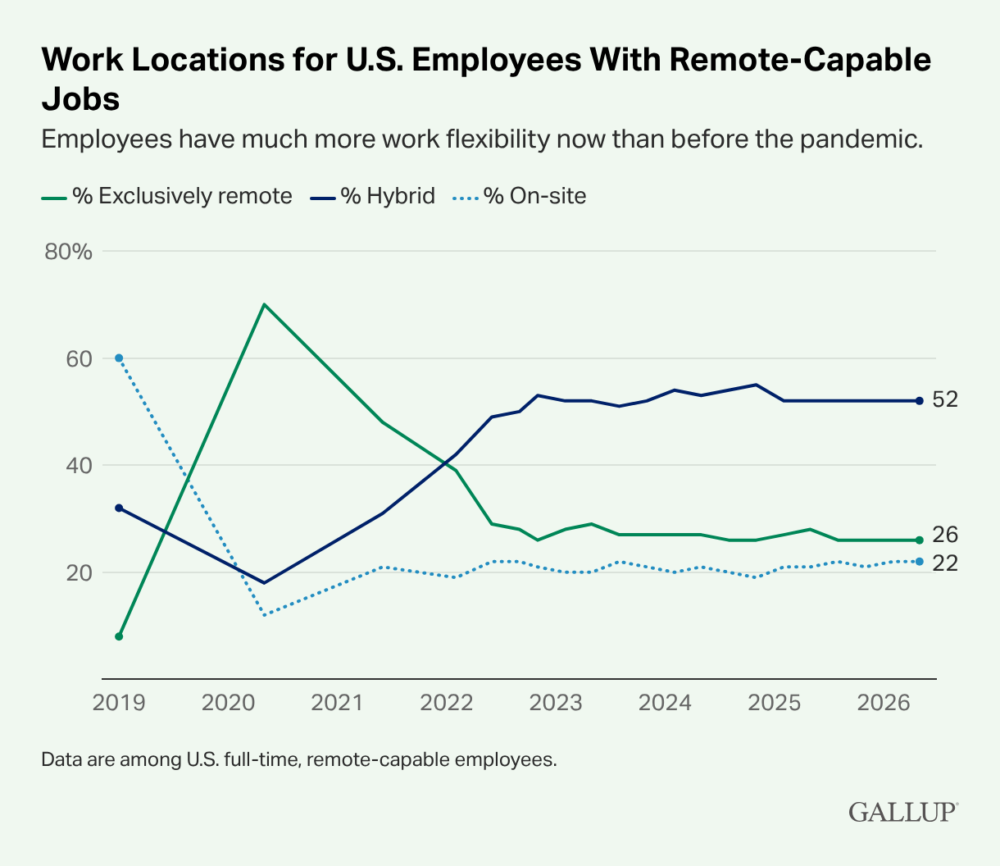
Image from Gallup
That mismatch shows up in engagement numbers. Among employees whose jobs could be done remotely, the ones working on site full time report 29% engagement, while hybrid workers land at 34% and fully remote workers reach 37%. The gap is modest but consistent.
A hybrid schedule is easy to set. Building a hybrid workplace culture around it is harder, because the schedule doesn’t determine what happens when half the team is in the room and half is on the call: who gets heard, and who finds out about the decision afterward.
Flexibility on the frontline
Nurses, drivers, line workers, and store staff can’t relocate their jobs, which is how the assumption took hold that flexibility isn’t for them. The evidence runs the other way. When UKG surveyed 8,200 frontline workers across ten countries, schedule flexibility came out second only to pay in whether people stay or leave, yet half said they struggle to swap a shift when something comes up at home.
The ask here is schedule control: predictable rosters, advance notice, and a workable way to trade a shift. For the operations leaders running those teams, it’s usually the only flexibility lever they have.
What a Flexible Work Culture Requires
A policy sets the rules, but a flexible work culture determines whether people feel safe using them. That part shows up in places no handbook covers:
- Who gets the interesting project after taking Fridays remote
- Whose camera-off day comes up in a performance review
- Which manager sighs when a shift swap request lands
None of it is written down, which is what makes it hard to fix. You can update a handbook quickly. Changing what people assume about who’s pulling their weight takes much longer.

One lever has better evidence behind it than most. Gallup found that teams where employees help set the hybrid policy report the highest sense of fairness at 90%, along with the strongest collaboration outcomes. Only 11% of employees work that way; the rest have theirs handed down.
Two things tend to make it stick:
- Name what’s fixed, alongside what’s flexible, so nobody has to guess where the edges are.
- Have senior people use it visibly. A director taking their compressed Friday does more for adoption than a paragraph in the handbook.
With employers offering less flexibility overall, each remaining piece carries more weight with the people deciding whether to stay. Most of that weight lands on middle managers, who approve the swap, notice the absence, and set the tone for everyone watching. A flexible company culture is mostly the sum of how those small decisions go.
Those managers are worth hiring deliberately. Recruiting Connection’s human resource recruiters work with employers across Utah to place HR leads and the operations managers who run flexible teams day to day. As one of the recruiting agencies in Salt Lake City with a local candidate network, we can screen for people who have run a split schedule before, not just worked inside one.
5 Flexible Workplace Strategies
These five flexible workplace strategies can make the most difference in practice.

1. Set clear performance measures
Flexibility works when both sides know what counts as finished. Without hours as the proxy, you need something explicit in its place: delivery dates, volume targets, quality thresholds, response times. Agreeing on those upfront protects employees as much as the business, since it gives them something concrete to point at when an empty desk gets read as less work.
2. Publish schedules further in advance
For shift-based teams this is the highest-value change available, and it costs nothing but planning discipline. Two weeks’ notice lets people arrange childcare, book appointments, and commit to things outside work. It also reduces the last-minute scramble on both sides of the roster.
3. Let teams set their own norms
Give each team a framework rather than a company-wide rule, and let them settle the specifics: which days they overlap, how they cover absences, what counts as a reasonable response time. Teams closest to the work usually land somewhere more practical than a central policy would, and people follow rules they helped write.
4. Apply it to shift-based roles
Self-scheduling tools, shift-swap systems, and predictable rosters do for frontline staff what hybrid does for desk workers. Leaving those roles out of the policy creates a visible two-tier system, and they’re often the hardest positions to keep staffed in the first place.
5. Review it on a set schedule
Put a date in the calendar, twice a year, to check what’s being used and what isn’t. Ask people directly instead of reading it off engagement scores. Policies drift — a rule written for a 40-person company stops fitting at 120, and arrangements built around one manager’s team tend to outlive the manager.
Where Flexibility Holds Up
The size of a flexibility policy matters less than how evenly it gets applied. A modest arrangement that everyone understands and managers honor will do more for hiring and retention than a generous one people hesitate to use.

If flexibility is part of how you plan to compete for people in Utah’s job market, it helps to hire managers who have run it before. As professional recruiters in Utah, Recruiting Connection covers the roles that determine how flexible a workplace really is.
We work as an HR recruiting firm for employers hiring the people who write and administer that policy. Our operations recruiters place the managers holding schedules together across sites, and our executive recruiters handle the leadership roles where these decisions start.
Contact our team today to find the people who can make it work.
Flexible Workplace: FAQs
What is workplace flexibility?
Workplace flexibility is the degree of choice employees have over when they work, where they work, and how many hours they put in. Employers set the limits, and employees make decisions inside them. It covers far more than remote work.
What are examples of flexible work arrangements?
Common arrangements include hybrid schedules, fully remote roles, flextime, compressed four-day weeks, job sharing, and shift flexibility like swapping and self-scheduling. Most companies run two or three at once rather than picking a single model.
What does a flexible work culture require?
A flexible work culture means people can use the policy without it costing them. That depends less on the handbook than on whether managers treat flexible arrangements as normal when assigning projects and writing reviews.
How do you build a flexible workplace?
Set clear performance measures so hours stop being the proxy for effort, publish schedules further ahead, let teams settle their own norms, extend the policy to shift-based roles, and review it twice a year.
Can frontline employees have flexible schedules?
Yes. Frontline flexibility looks like predictable rosters, advance notice, and a workable way to trade shifts. UKG found schedule flexibility ranks second only to pay in whether frontline workers stay or leave. For many operations teams, it’s the only flexibility lever available.
SHARE


Struggling to find top
talent for your business?
Connect with the expertes at Recruiting Connection and discover the difference our full-service recruitment can make.
Contact Us Today