

State of Remote Jobs in Utah: Key Statistics and Trends

📝 Key Takeaways
Remote work in Utah has fallen from its 2021 peak but still runs roughly double pre-pandemic levels, and the state ranks 9th in the country.
- Utah’s work-from-home rate dropped to 15.7% by 2024
- Information and professional services lead; frontline industries stay in single digits
- Degree holders and higher earners work from home most
- Just 18% work from home, though most jobs allow it
Remote work in Utah peaked in 2021 and has been receding ever since, but it hasn’t gone back to where it started. Utah still has roughly twice as many home-based workers as it did before the pandemic, and it ranks among the top 10 states for the share of its workforce based at home.
What’s changed is who works from home. Government employees have largely returned to the office. Self-employed Utahns have moved the other way. The gap between college-educated workers and those without a diploma has widened.
For employers, that matters more than the headline number. Remote flexibility now concentrates in specific industries and among specific groups, which makes it a targeted hiring tool you apply role by role.
The State of Remote Work in Utah
1. Remote work has declined, but remains double pre-pandemic levels
After nearly tripling from 118,000 to 327,000 workers between 2019 and 2021, the number of Utahns working from home fell to 278,000 in 2024, a drop of 49,000 or 15%, according to a July 2026 research brief from the Kem C. Gardner Policy Institute. The statewide rate fell from 20.0% in 2021 to 15.7% in 2024.
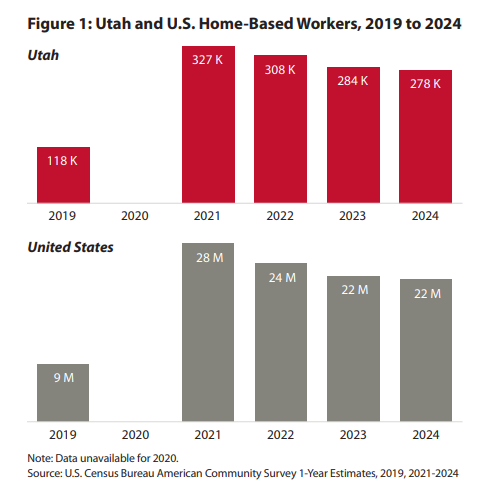
Nationally the pattern was the same, with remote workers dropping from 28 million in 2021 to 22 million in 2024, a 20% decrease. Both nationally and in Utah, the declines have been slowing each year.
Utah ranked 9th nationally in 2024, up from 12th in 2021, though that reflects steeper declines elsewhere rather than growth here. Utah ranked 3rd before the pandemic. Five western states now sit in the top ten: Colorado 2nd, Oregon 3rd, Washington 4th, Arizona 5th, and Utah 9th.
2. Information and professional services lead by a wide margin
Remote work concentrates heavily by industry. Nearly 2 in 5 Utahns in the information industry work from home, at 39.8%, a rate that has held steady for three years. Professional, scientific, and management services follow at 33.3%, and finance, insurance, and real estate at 32.3%.
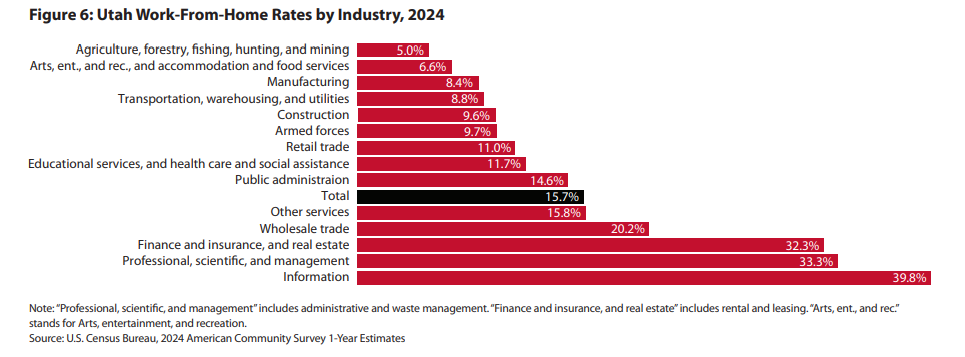
At the other end, agriculture, forestry, fishing, hunting, and mining sits at 5.0%, with arts, entertainment, recreation, accommodation, and food services at 6.6%. Manufacturing is 8.4% and construction 9.6%.
Working from home declined in 11 of Utah’s 16 industries between 2021 and 2024, with professional services and finance each falling more than 7 percentage points.
3. Occupation predicts remote work better than industry
Credit authorizers work from home at 77.0%, loan clerks at 58.7%, private investigators at 57.3%, software developers at 45.2%, and graphic designers at 42.9%. Meanwhile about 1 in 4 Utah occupations have no home-based workers at all, including dentists, aircraft mechanics, tile installers, roofers, and paramedics.
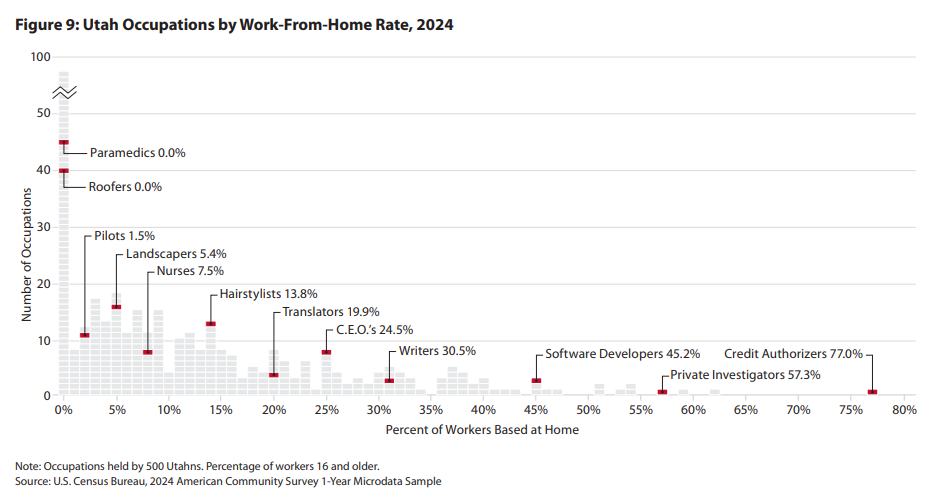
The gains and losses since 2021 are the more useful split. Insurance sales agents, inspectors, medical and health services managers, and software developers added the most home-based workers. The largest decreases hit managers, customer service representatives, bookkeeping and accounting clerks, postsecondary teachers, and receptionists.
Technical and professional roles kept their flexibility. Administrative and support roles largely lost it.
4. Government workers returned to the office; the self-employed went remote
The sharpest reversal came in the public sector, where the work-from-home rate fell from 28.2% in 2021 to 9.8% in 2024. The decline tracks national hybrid work trends, with most of those roles moving to part-week attendance rather than full-time office work.
Private-sector workers saw an even larger drop in absolute terms, from 39.4% in 2021 to 16.0% in 2024. Self-employed Utahns moved the other way, rising from 19.8% to 29.0%, the only class of worker to increase.
5. Education and earnings predict who works from home
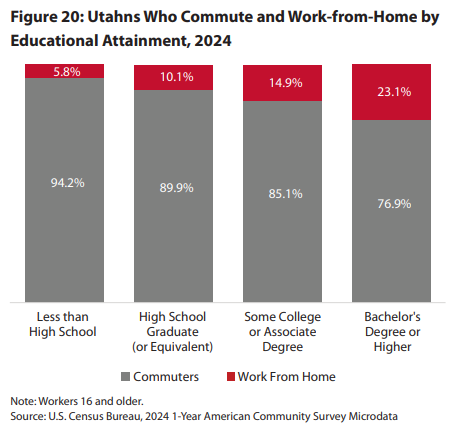
The divide by education is stark and widens at every step. Just under 6% of Utahns without high school diplomas work from home, against 10.1% of high school graduates, 14.9% with some college or an associate degree, and 23.1% with bachelor’s degrees or higher.
Earnings follow the same line: 22.9% of workers earning $75,000 or more work from home, against 12.4% of those earning $25,000 to $49,999. Home-based workers also report lower poverty rates and higher median earnings than commuters.
That reverses the pattern earlier coverage described, when Utah stood out for extending remote work across education levels.
6. Women work from home at higher rates than men
In 2024, 17.3% of employed Utah women worked from home, compared to 14.4% of employed Utah men, a gap that has held for the past decade and mirrors the national split.
Among the 145 Utah employers recognized in USU’s 2026 Companies Championing Women report, flexible arrangements were the most widely adopted practice, with 87.6% offering flexible hours, 85.5% offering remote work, and 72.4% offering quality part-time positions. Those employers tied flexibility directly to recruitment and retention, particularly for women managing caregiving.
7. Age and tenure shape it too
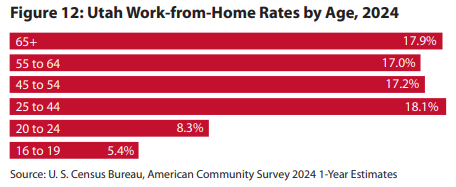
Remote work is uniform across workers 25 and older, at 17% to 18% in every age bracket. It drops sharply below that: 8.3% for workers aged 20 to 24 and 5.4% for those 16 to 19.
Recent movers are also less likely to work from home than settled residents, at 12.2% against 16.7%, a relationship that reversed in 2023. Before then, people who had recently relocated were the more likely group.
8. Remote work by county
Among Utah’s most populated counties, the highest 2024 rates were Utah County at 17.7%, Davis at 17.5%, Salt Lake at 16.3%, Washington at 15.7%, and Tooele at 15.6%. Cache sits at 13.2%, Weber at 13.1%, and Iron at 9.6%.
Using five-year estimates, which cover smaller counties, Piute, Summit, and Wayne counties reported the state’s highest rates between 2020 and 2024, all above 20%. Nine rural counties, including Carbon, Emery, Duchesne, Uintah, and Sanpete, sit below 10%.
Only Cache and Washington counties held their elevated pandemic-era rates. Salt Lake, Utah, Davis, Weber, and Tooele all peaked and then declined.
9. Utah ranks #1 as a place to work from home
Separately from how many Utahns actually work remotely, WalletHub’s 2026 study ranked Utah the best state in the country for working from home, with a score of 70.07 out of 100, first for living environment and ninth for work environment across 12 metrics.

The drivers are practical: the largest homes in the country at an average of 2,459 square feet, sixth-lowest electricity costs, sixth-lowest internet costs, and tenth for household internet access. WalletHub also found that while 18% of Utah’s workforce currently works from home, more than 95% hold jobs that could be done remotely.
That gap is the number worth watching. Employer policy sets the ceiling on remote work in Utah, well before the nature of the work does.
What This Means for Utah Employers
The numbers above describe the market. Here’s what follows from them.
1. Match the arrangement to the role
One company-wide policy will be wrong for part of your workforce. Information and professional roles sit near the top of the state’s rates; production, construction, and frontline service roles sit in single digits.

Occupation matters more than industry. A manufacturer employing software developers and accounting clerks is running two labor markets under one roof.
2. Expect flexibility to come up most in senior searches
Workers who kept working from home are disproportionately the ones already employed and weighing multiple offers. The benefits of remote work for employers show up most clearly here: for senior engineering, finance, and professional roles, an in-office requirement narrows your pool measurably.
That’s a legitimate choice, but it gets paid for elsewhere, in compensation, scope, or schedule control. The cost shows up as a longer search, which makes it easy to miss until the role has been open a quarter.
3. Know which of your roles are losing flexibility
The occupations that shed the most home-based workers since 2021 are administrative and support functions.
If you’re hiring a receptionist or a bookkeeping clerk, an on-site requirement is unlikely to cost you candidates. If you already offer remote work in those roles, that’s now a scarce retention advantage worth keeping.
Sorting that by role is most of the work. Recruiting Connection helps Utah employers decide which openings need flexibility and which don’t, and as human resource recruiters we place the HR and people-ops staff who write and administer those policies. For engineering and IT roles, where the arrangement often decides the shortlist, our tech recruiters know what candidates currently expect.
4. Use flexibility to widen your shortlist of women candidates
Utah women work from home at higher rates than men, and the employers in USU’s Companies Championing Women report tied flexibility directly to recruitment and retention.
The range is what makes it copyable. Those 145 organizations run from fewer than 10 employees to more than 1,000, so none of it requires a large HR function.

5. Let remote-capable roles widen your geography
Posting remote jobs in Salt Lake City draws candidates well beyond the county line: an employer hiring for a remote-capable role can reach Summit, Davis, Utah, and Washington counties without asking anyone to relocate.
The constraint runs both ways. Nine rural counties sit below 10%, so a remote posting won’t reach much of a local pool there.
6. Watch the public sector for available candidates
Government remote work in Utah collapsed over three years, and state agencies now expect most employees on site at least part of the week.
That puts experienced administrative, finance, and IT professionals back into the commuting market, and some of them are weighing whether to stay. They’re worth approaching directly.

7. Check whether your policy matches your candidate pool
The gap between what could be done remotely in Utah and what actually is means the ceiling here is set by employer policy, not by the work.
That cuts both ways. You can’t claim a role must be in-office when candidates know otherwise, but you don’t have to offer remote work just because the job allows it. You do need a reason you can state plainly, because candidates will ask.
Two groups where the assumption breaks down: noncitizen workers in Utah work from home at 7.2%, less than half the 16.4% rate for citizens at birth, and workers under 25 at roughly half the rate of older colleagues. For those candidates, mentorship and being in the room may matter more than flexibility.
Hiring for the Way Utah Actually Works
The future of remote work in Utah looks concentrated and durable, strongest in exactly the roles that are hardest to fill. For most employers, the practical question is which of your openings genuinely compete on flexibility, and what you’re putting on the table in the ones that don’t.

Recruiting Connection has worked with Utah employers through both ends of this shift. As leading professional recruiters in Salt Lake City, we help companies define which roles need flexibility and find candidates who fit the arrangement. For leadership hires, our executive recruiters manage the search from role definition through offer.
Reach out to our team today to find the talent that fits how your company works.
Remote Work in Utah: FAQs
What are the remote work statistics and trends in Utah?
Remote work in Utah peaked at 327,000 workers in 2021 and fell to 278,000 by 2024, a 15% decline, according to the Kem C. Gardner Policy Institute. The statewide rate dropped from 20.0% to 15.7%, yet Utah still ranks 9th nationally and retains roughly twice as many home-based workers as before the pandemic.
How many remote jobs are available in Utah?
SimplyHired listed roughly 2,086 open remote work Utah positions as of late 2026, spanning roles in customer service, healthcare, sales, and AI training, with pay ranging from around $15 to $150 per hour depending on the position and experience level.
What types of remote jobs are most common in Utah?
The most common remote jobs in Utah are concentrated in information, professional services, and finance. Top remote occupations include software developers at 45.2%, graphic designers at 42.9%, loan clerks at 58.7%, and credit authorizers at 77.0%, with technical and professional roles holding the highest work-from-home rates.
Do remote workers in Utah have to pay state taxes?
Yes, remote workers in Utah are generally required to pay state income tax on income earned while working remotely. Utah follows the physical presence standard, meaning income is taxed based on where the work is performed, and Utah residents must report all remote work income on their state tax return, regardless of where the work takes place.
What should Utah employers know about hiring remote workers?
Utah employers should know that remote work flexibility is concentrated in senior technical, finance, and professional roles, where an in-office requirement measurably narrows the candidate pool. Matching the arrangement to the specific role rather than applying a company-wide policy is key, as administrative and frontline roles have largely returned on site.
What are the best job boards for finding remote work in Utah?
For remote work in Utah, job boards such as FlexJobs, Dynamite Jobs, Jobspresso, Remote.co, Virtual Vocations, and No Desk are recommended by Utah State University’s Rural Online Initiative. FlexJobs screens all employers and listings to protect users from scams, making it a particularly trusted option for finding legitimate remote positions.
SHARE



Struggling to find top
talent for your business?
Connect with the expertes at Recruiting Connection and discover the difference our full-service recruitment can make.
Contact Us Today